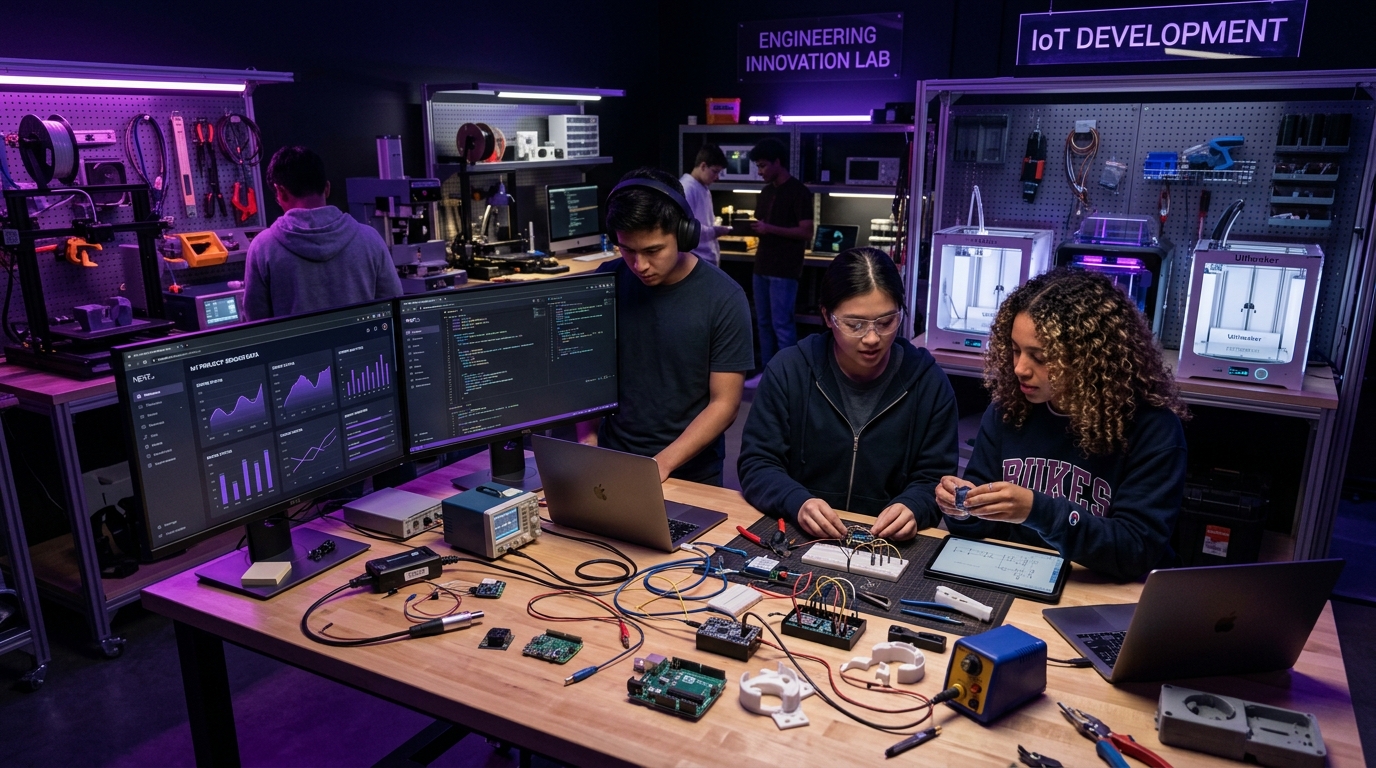
Building Student Projects at Scale: How We Deliver in 48 Hours
The systems, templates, and internal workflows that allow Ugam Campus to consistently deliver professional-grade engineering projects in days instead of weeks.
Every semester begins with the same cycle.
Students receive a final-year project requirement. Enthusiasm lasts a few days. Then reality arrives: the problem statement is unclear, the technology stack is unfamiliar, components need to be selected, documentation has to be written, presentations are due, and viva examinations are approaching.
Most students are not struggling because they lack intelligence. They're struggling because engineering projects require a process, and nobody teaches the process.
That's the problem we set out to solve.
From Project Building to System Building
When we delivered our first few projects, everything was custom. Every requirement was analyzed from scratch. Every architecture decision was debated. Every documentation template was rebuilt.
The projects worked. The process didn't.
As demand grew, we realized we weren't building engineering projects anymore—we were building a project delivery system.
Today, every project moves through a standardized internal workflow that dramatically reduces delivery time while maintaining quality and customization. We call it the Alchemist Protocol.
The Alchemist Protocol
Initialization
Understands the actual problem. Identifies core objectives, expected outputs, hardware/software requirements, academic constraints, and evaluation criteria. Eliminates ambiguity before development begins.
Architecture
Designs the system blueprint: component selection, tech stack selection, database design, communication architecture, UI planning, and documentation structure.
Execution
Hardware and software integration: IoT integration, embedded programming, web applications, mobile interfaces, cloud deployment, and live dashboards.
Validation
Functional testing, sensor calibration, error handling validation, performance verification, and live demonstration prep. Completes only when consistent under real usage.
Viva Preparation
Documentation, report preparation, PPT creation, architecture explanation, Q&A prep, and demonstration strategy. Empowers students to defend their project with complete confidence.
The Template Advantage (The 70/30 Rule)
People often assume speed comes from shortcuts. In reality, speed comes from reuse. Across dozens of projects, we've discovered that roughly 70% of engineering work is structurally similar.
Instead of rebuilding ESP32 MQTT controllers or Next.js database foundations every time, we maintain proven templates that accelerate development. That allows us to focus our energy on the remaining 30%—the unique logic that makes each project different.
Why This Works
Projects take days instead of weeks because architectural decisions are pre-validated.
Proven architectures eliminate implementation errors & random hardware bugs.
Students build alongside us so they can confidently defend their project viva.
“When the process is engineered correctly, delivering professional-grade projects in 48 hours becomes not an exception—but the standard.”
Why Manufacturing Dashboards Fail (And How WireFlow Solves It)
Most factory software is built by people who have never spent a day on a plant floor. The result is dashboards full of information—and empty of action.
Why We Obsess Over 14ms Latency (And Why You Should Too)
Understanding the invisible threshold of human perception and why real-time systems need to be genuinely real-time.